
Tekan tombol untuk:




The Red Chrysanthem
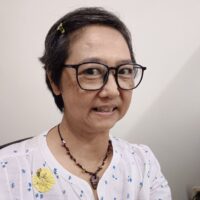
Purwanti Kusumaningtyas adalah pengajar di Jurusan S1 Sastra Inggris, Fakultas Bahasa dan Seni, Universitas Kristen Satya Wacana, Salatiga, Jawa Tengah. Dia memperoleh gelar master dan doktor dari Jurusan Pengkajian Amerika, Fakultas Ilmu Budaya, Universitas Gadjah Mada, Yogyakarta.
Dia tertarik pada banyak hal, termasuk naik gunung dan menjelajah, penulisan puisi dan cerita pendek. Dia telah menerbitkan puisi dan cerita pendek, antara lain dalam buku kumpulan puisi “Furtive Notions” (DeePublish 2022) dan kumpulan cerita pendek “They Are Here” (DeePublish 2023). Beberapa puisinya telah dibuat musik dan ditampilkan dalam berbagai acara nirlaba dan kemanusiaan, termasuk dalam acara LETSS Talk, lembaga pejuang kesetaraan perempuan yang terpercaya di Indonesia serta Festival Musik Rumah (FMR).
Dia sudah bekerja dengan Dalang Publishing sejak 2013, yaitu sejak dia mengenal penerbit yang memiliki semangat yang sama untuk melestarikan dan memperkenalkan keragaman Indonesia pada dunia.
Purwanti dapat dihubungi melalui: purwanti.kusumaningtyas@uksw.edu
****
The Red Chrysanthem
Early August 1989
Sunrays permeate the woven bamboo walls, casting shadows like the bars of a cage. Children’s laughter drifts in, mingled with the distant hum of the market. In the yard, a red chrysanthemum stands in full bloom. Inside the hut, it is quiet and cold.
Mirah sharpens the Japanese tanto. The steady rasp of the short sword’s blade against gray whetstone intensifies the chill, as her steady, rhythmic strokes scrape brown rust off metal. Her veined, gnarled hands resemble the roots of an old banyan tree. After several minutes, she stands and stares at the blade. Her clouded eyes reflect the grief she had buried and endured for years.
“It’s time,” she mumbles.
She rises, hangs up her old shawl, and puts the tanto away in its iron case. She looks around at a room filled with memories. On a shelf of the bamboo rack sits an old framed photograph of herself with Bagas, her husband. She dusts it with the long sleeve of her kebaya blouse and straightens it properly. Then, she sits down, facing the half-open door. A sunray draws a shadowed line across her face, as a waft of wind carries in the pungent market scents of herbs and fried snacks. A chirping warble from the roof breaks into the quiet, then suddenly stops, as if scared away. Time moves like a relentless clanging bell in Mirah’s heart. After twenty-four years, the day she’s been waiting for is here, though she never expected that, as the sun creeps through her bamboo walls, she would feel such peace.
December 1965
When they first heard the news about the Indonesian Army generals being kidnapped in Jakarta on the night of September 30, 1965, Mirah, her husband, and their fellow villagers did not really understand what had happened in the capital. They only heard hazy comments such as, “There’s been a coup,” and big words like “betrayal” and “communist.” For them, it was nothing more than hearing the rumble of a faraway storm.
But soon, the faraway storm arrived full force at nearby villages. The state’s radios spread the news that the Army generals had been killed and thrown into an old well. In the market, people whispered about the country’s cleansing of traitors. Military trucks now shared the dirt path with people, horse carts, and bicycles. Banners, draped around the district centers, reminded people of the Indonesian Communist Party members and supporters. “Communist” became an incantation that people spat out to curse anyone at will.
Fear grew like weeds. People eyed each other suspiciously. The authorities listed institutions and their activists — anyone who attended the peasant meetings, those who read the leftist daily news, whoever was seen attending women communities. Even those who didn’t know anything about politics could become suspects and face arrest.
At night, people heard military trucks stop at the outskirts of the village, headlights sweeping the houses like a monster seeking prey. Sometimes they took a neighbor away. Sometimes they took several neighbors at once. They tied their victims with rope and wire, then shoved them onto the truck bed, like sacks of rice. Not everyone returned home.
Hearing the news about the arrests in the neighboring village, Mirah remembered how Bagas, one night while offering her a red chrysanthemum, said softly, “These are only city politics. They won’t reach this village.”
But city politics had long legs that traveled to the villages along dirt paths, in the guns slung over soldiers’ shoulders, and through the fear imposed on the villagers. And, later, when city politics burst into their home on a December night, it didn’t come as news, but as boots, rifles, and echoing screams across the yard.
One cold night, a truck and jeep arrived at the house, carrying a group of soldiers. After parking their military vehicles in the front yard, some jumped out and stormed through the open door. Inside, they punched a startled Bagas in the face. Mirah came running from the kitchen and tried to embrace her husband, but the soldiers pulled her away and forced the two of them out of the house. Bagas begged the soldiers to let them go. One soldier struck Bagas with his rifle’s butt, and Bagas fell, his face bleeding.
“PKI! Gerwani!” Soldiers shouted the names of the banned Indonesian Communist Party and the Indonesian Women Movement affiliated with it. One of the soldiers kicked Bagas in the back, then shoved him to get up. “Communist!”
Soldiers tied Mirah’s and her husband’s hands and escorted them to the front yard, passing the two rose apple trees. Along the street, neighbors and friends watched in fearful silence. Mirah saw her escort nod, and her husband was taken behind the starfruit tree, a few meters away from the rose apple trees. Startled, Mirah suddenly realized what was about to happen, and tears began to fall. Away in an empty field, lit only by silvery moonlight, the soldiers stripped away Mirah’s dignity.
The next morning, still stunned, she searched for Bagas. In the shallows of the river at the end of the village, she found him dead, his hands still tied with rope. He looked like an offering in the turbid water. His lifeless eyes, opened wide, expressed dread. A short bloody sword lay beside him on the bank.
Mirah could still feel the soil pressing into her as the soldiers took their turns with her. She could still smell their sweat and the rancid scent of blood, as other soldiers stood around watching or, pretending not to see the savagery in front of them, looked away. She had stored those faces in her memory.
Since that night, Mirah knew that history was not always written in books. Sometimes it was inscribed on the body — as a wound, a memory, and a prevailing silence. As the years passed, she was aware of the seasons changing, but could still only feel that dirt against her back, near that river, on that night. She became a walking stone, breathing but not alive, waiting for something that would never come.
August 17, 1989, Independence Day
“Mbok Mirah.” Hesitantly, Fadil calls the old woman from outside the hut.
Mirah startles and lifts her head, as if emerging from a long tunnel. Echoes from the past always resurfaced when someone called her name. She looks at the half-open door. It personified the past, knocking softly, never really moving on, but always waiting for the door to open wide.
Fadil, the village head, stands outside the door. His father had told him about the terrible ordeal Mirah endured in 1965.
“What do you want?” Mirah asks softly, her voice catching in her throat. Something inside her trembles — she feels caught between the urge to shut the door and the exhaustion of always hiding.
“Tonight, there’s a celebration at the village hall,” Fadil says. “It’s a simple gathering to reflect on our independence and give thanks. Will you join us?”
Mirah’s eyes narrow. The word “independence” feels both foreign and painful. To her, nighttime is no longer a time for reflection or giving thanks, but a place haunted by shadows of the past. She says nothing, seeing the faces of those who had stood by and watched as the soldiers stripped her dignity.
“All right,” Fadil finally says, “you rest.” He turns to walk away, then stops. “Please, forgive me,” he says softly. “It has been twenty-four years. Maybe it’s time to forget and make peace with it.”
Mirah chuckles bitterly. “Forget? Make peace with it?” she whispers. “Who will remember the innocent blood? Who will remember the terror that night? Who will assume responsibility for the horror?”
Mirah feels a chill in the hut, her chest raw and ragged. For a long time, she sits, staring at the door she had closed against Fadil. She knows Fadil won’t bother her anymore that night, but his voice keeps drilling into her mind. Forget.
Slowly, she opens the drawer under the bamboo divan and takes out a faded brown envelope. One edge is peeled. She opens it carefully and takes out a stained black-and-white photograph. In it, a faded young Bagas sits on the front porch of their old house, holding the violin he was learning to play. Beside him stands young Mirah, both smiling, happy and content, with no hint that just one month after the picture had been printed, blood would cover the soil beneath them.
Mirah strokes Bagas’s face in the picture, then looks up at the ceiling, her husband’s face still in her mind. No, she would never forget him. She might be able to forget other things, but she would remember Bagas and that December night until her last breath. Her eyes flash. Bagas was not a communist, and neither was she! Bagas only wanted to learn to play the violin. And even if Bagas had been a communist, the soldiers didn’t have the right to kill him.
Mirah rises. From beneath the screw pine mat, Mirah pulls out the gunny cloth she uses as her sleeping pad. She reaches for the iron case, unlocks it with the small key she carries in her hair bun, and removes the newly sharpened tanto that had murdered her husband. The red cloth that swaddles it is worn, but she can still knot it — as tight as the knot of the dark memory she would never unravel.
Mirah unsheathes the tanto slowly and stares at it. She used to be afraid to touch it. Now, she sways it confidently in the air. Her movements are slow, as if carving vengeful letters in the air. Every movement of her hand expresses the dark memories: the thump of the rifle butt, Bagas’s screams, the neighbors’ blank stares when they pretended not to see her being dragged out of her yard. One of the soldiers who came to her house that night had been a neighbor. Perhaps he hadn’t defiled Mirah or killed her husband, but still, he was a part of her revenge. For her, the uniform and his obligation as a soldier were enough to make him a part of her wound.
If I walk into the celebration of independence tonight with this sword in my hand, will they remember?
Mirah opens the window. Market smells hang in the air. Now she hears the faint sound of the Javanese gamelan orchestra from the village hall, indicating that the festivities will start soon. She looks out at the nearly full moon, just as it had been the night Bagas was thrown into the river’s shallows. She stands for a moment, then closes the window. Tonight will belong to people like her, people who were never given a space to voice justice. Tonight, she wants everyone to know that she will settle a score.
Mirah opens her old wardrobe and takes out a shabby white-laced kebaya. She touches every patch, as if reading wounds. Tonight is hers. It didn’t belong to the independent country that ignored her; it belongs to Bagas. It belongs to them both.
The torches in the yard of the village hall flicker from afar. The villagers, old and young, have gathered to hear speeches by important figures and sing patriotic songs. A group of enthusiastic teenagers performs an inspiring play about Indonesian independence.
Before entering the crowded yard, Mirah stops and stands perfectly still. The torchlights cast her silhouette on the crowd. Surprised, several people stare at her — they have never seen her attend such events. Fadil, the only one who recognizes her, rises.
Mirah walks steadily to the middle of the yard, gripping the tanto wrapped in red cloth. She is comfortable wearing her old kebaya — the shabby one with patches like wounds.
“Mbok Mirah?” Fadil, looking happy, moves to welcome her.
Mirah ignores him and, stopping in the middle of the crowd, slowly unwraps the tanto. Shocked, the spellbound people fall quiet.
“This …” Mirah’s coarse voice rings loud and clear. “This sword killed my husband twenty-four years ago. I kept it all these years, waiting for someone to bring me justice. But no one did.”
The night air suddenly turns icy. The crowd, standing dumbfounded, stares at her.
“But tonight,” Mirah lifts the sword, “I will free myself from revenge.” She looks at Fadil. “That’s what you asked me to do, isn’t it? Forget? Make peace? All right, then, I will!”
People are mumbling, wondering what she wants. Fadil is about to say something, but then, Mirah plunges the sword into her heart.
People scream and scatter. Fadil lunges to catch Mirah as she sways, but she falls to the ground. Fadil drops down to embrace her and looks into her pale face. Then, gently closing her eyelids, he pulls the sword from her chest. The wet sword shines, reflecting the light of the torches.
After the funeral, the villagers spread red chrysanthemums over the village hall’s blood-stained yard — the same yard where they celebrated their country’s independence.
*****