
Tekan tombol untuk:




The Cracked Jar
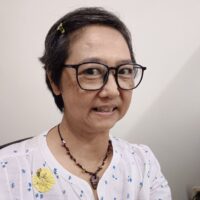
Purwanti Kusumaningtyas adalah pengajar di Jurusan S1 Sastra Inggris, Fakultas Bahasa dan Seni, Universitas Kristen Satya Wacana, Salatiga, Jawa Tengah. Dia memperoleh gelar master dan doktor dari Jurusan Pengkajian Amerika, Fakultas Ilmu Budaya, Universitas Gadjah Mada, Yogyakarta.
Dia tertarik pada banyak hal, termasuk naik gunung dan menjelajah, penulisan puisi dan cerita pendek. Dia telah menerbitkan puisi dan cerita pendek, antara lain dalam buku kumpulan puisi “Furtive Notions” (DeePublish 2022) dan kumpulan cerita pendek “They Are Here” (DeePublish 2023). Beberapa puisinya telah dibuat musik dan ditampilkan dalam berbagai acara nirlaba dan kemanusiaan, termasuk dalam acara LETSS Talk, lembaga pejuang kesetaraan perempuan yang terpercaya di Indonesia serta Festival Musik Rumah (FMR).
Dia sudah bekerja dengan Dalang Publishing sejak 2013, yaitu sejak dia mengenal penerbit yang memiliki semangat yang sama untuk melestarikan dan memperkenalkan keragaman Indonesia pada dunia.
Purwanti dapat dihubungi melalui: purwanti.kusumaningtyas@uksw.edu
****
The Cracked Jar
Thick fog filled the upstream valley of the Mahakam River as the wooden boat, docked at the village harbor Ping had left long ago. She remembered sitting on her grandmother’s porch as a child, listening to tales about their ancestors. She now returned, no longer an excited child, but a researcher investigating the local farming wisdom of the Bahau Dayaks. Yet it was not just an academic task that prompted her return. It was also her longing to hear the grand gong, the melodious lute-like music plucked from the sape, and stories about the jungle. According to her grandmother, that lowland rainforest, crowded with shady light-red meranti trees and Kalimantan ironwoods, was the home of the ancestral spirits.
A tanned village girl waited for Ping at the end of the pier. She had slanted, sharp eyes and wore her hair in a long pigtail beneath a faded lavuung, the Bahau Dayak head scarf. “Ika’ sa’ Ping?” the girl greeted her, confirming Ping’s name.
“Ii’.” Ping nodded and, even though she felt awkward speaking in the Bahau Dayak language, she confirmed the girl’s name. “Ika’ alang Tukau?”
Tukau nodded and continued in Bahasa Indonesia. “I was assigned by the head of the kampong to accompany you. The village chief said that you wanted to write about Hunai, the rice goddess.”
Ping smiled. “Yes, about Hunai and our homeland.”
Tukau stared across the river at land deforested by the mining company. “You’ve come at the right time. Our homeland is under a big threat. The mining companies and oil palm plantations have come, one after the other, for the last decades.” Tukau’s voice rose.
“Those city folks told us this was all about sustainable development that would improve our village. But now, we’re only left with a smelly river polluted with oil and dead fish that floods the land every year. And we constantly have to find new fresh water sources. We no longer hear birds singing or other wild animals — we only hear the noisy, heavy-duty machines of logging equipment.”
Ping was recording Tukau with her smartphone. As Tukau kept staring at the denuded hill, Ping became restless. “Yes …,” she said softly, “city people talked about sustainable development … said it was for the village’s good.”
Tukau smiled sadly. “They talk about building something grand that destroys the land. They grow oil palm trees, but we, the Dayaks here, lost everything.”
Ping’s journey to the traditional house in her village felt like a dream. Every step she took tossed her between two worlds – the past and the present.
***
That evening, Ping and Tukau were sitting on the porch of the village chief’s house, where Ping was to stay during her research trip. A plate of pitoh sat in front of them. The fragrance of the steamed sticky rice with grated coconut and palm sugar kindled Ping’s childhood memories.
Ping ate the pitoh with mixed emotions. In the past, she would have heard crickets chirping and seen thousands of stars in the sky. Now, despite it being evening, the steady drone of heavy equipment reached them from far away. She couldn’t see even one star in the dark sky.
Tukau stared at the black river shimmering in the dim moonlight. “We used to bathe in that river and take our drinking water from it.” She sighed. “Now, we don’t dare wash our clothes in the river, and the children get rashes if they even touch the water.”
Ping looked at the oil-slicked water, and for the first time, as a researcher, she felt disturbed. Up until now, she had written about Kalimantan from a far-away, air-conditioned room, without witnessing its real condition. She remembered one of her college lecturers telling the class, “When doing our research, we must free ourselves from our personal interest and biases to the subject matter. This detachment keeps the work from being tainted by personal feelings.” But here, on the banks of a ruined river whose destruction turned it from a life-giving asset to a worthless liability for the sake of development and improvement, Ping felt a noncommital attitude would equal a betrayal.
***
Several days later, Tukau took Ping for a walk along the muddy riverbank. Uprooted trees, piles of washed up household garbage, and the still lingering stench of oil spills gave testament to recent flood damage.
Tukau suddenly squatted near a fallen tree and cried out, “Look at this!” Wedged between the tree’s exposed roots was a cracked clay jar. “This looks like an ancestral relic!” Tukau exclaimed, reaching for the jar. “Such items are usually kept in the amin ayaq because the village’s big traditional house can keep heirlooms like this safe.”
Ping helped Tukau clean the jar. Inside it, they found a piece of cloth and some worn beads, as well as a baliiu. The rusty, short dagger appeared to hold a story of the indigenous people’s lives which, like the flood-eroded riverbank, was mostly demolished.
Tukau gasped. “These are the ceremonial items are my grandmother mentioned!” she exclaimed. “They are the traditional heirlooms used to pray for the soil’s fertility at the Nebiing ritual.” She took a breath to calm herself. “My grandmother told me these had been lost during the big flood. We thought we had lost them forever, so our traditional elders made replacements. But here they are!” Tukau’s voice caught. “It turns out they had just drifted away to this riverbank.” Ping patted her shoulder.
***
The unexpected find made Ping realize that the problem was far greater than just the environmental damage — it was the destruction being done to the indigenous people’s collective memories and traditions. Every felled tree and polluted river represented the loss of priceless legacies.
That night, there was a black-out. By candlelight in the village chief’s house, Ping asked Tukau to tell her the legend of Dewi Hunai, the rice goddess. Tukau agreed, and Ping turned on her recorder.
“The story about Hunai begins in Apau Lagaan – the heavens, where gods, goddesses, and ancestors’ spirits live. At that time, the population on earth grew while food sources dwindled, causing famine and killing many people. So the elder gods chose Hunai Mebaang, one of the angels in heaven, to become the rice goddess, by sacrificing her blood to fertilize the rice crop that was the main food source for the people on earth.”
Ping listened attentively as the candle’s flickering flame danced like spirited shadows.
Tukau continued, “The elder gods transformed two women from heaven into birds — one a lesser coucal and the other a red-breasted partridge, the symbols of fertility. The birds were assigned to sprinkle Hunai Mebaang’s blood onto the fields.” Tukau’s voice softened. “From each drop of blood that hit the ground, a rice plant sprouted. That’s why the Bahau Dayaks regard rice with such high respect. It is the symbol of blessings and life.”
Ping was silent for a long time. Her sensibilities were in turmoil. Initially, she had regarded Tukau’s story as just an old folktale. But her conscience now started to believe that every ancestor’s story carried a particular wisdom.
“I know,” Tukau said quietly, “it’s hard for you who grew up in the city to accept such a story. But, the story about Hunai is not just a fairytale. It is a reminder that life is derived from sacrifice, and our land contains a spirit worthy of respect.”
Ping bowed her head. “I want to believe,” she whispered, “but, growing up, I was taught to think logically and always rely on scientific evidence. Land, to me, is a scientific entity, not a living thing we can converse with.”
Tukau patted Ping’s shoulder. “In that case,” she said softly, but firmly, “You need to start to learning from the land, herself. Let her speak to you directly.”
That night, Ping’s late grandmother visited her in a dream. For the first time since she was in high school, she conversed with her grandmother in the Bahau language – the language her grandmother had taught her, but she had never mastered. Born and raised in the city, she spoke Indonesian and sometimes a foreign language. In her dream, Ping greeted her beloved Bo’ Yoh and told her that she now understood her grandmother’s story about Hunai the rice goddess and other indigenous folklore. She admitted to her grandmother that she used to think the stories were nothing more than fairytales. Now, however, she understood that those stories were the ancestors’ way to relay messages about their identity and nature that supports their lives.
***
The following day, Tukau took Ping to visit an elder who lived at the outskirts of the village. Bo’ Huriing, a ninety-year-old woman, still vividly remembered the old ways villagers used to live.
“You’re Liruung’s granddaughter?” she asked Ping. “Your grandmother knew we had a sacred forest on that hill,” Bo’ Huriing said in her coarse voice. “That was before modern technology came. Now, the forest has almost disappeared.”
“Why didn’t our people stop the companies from cutting the trees?” Ping asked.
Bo’ Huriing took a deep breath. “At that time, young people said we villagers were outdated elders. They wanted to live like city dwellers and wouldn’t listen to us.” Bo’ Huriing’s clouded eyes stared into the distance as if trying to see into the past. “Our ancestors’ story about Hunai, who sacrificed herself so human beings would not die from starvation, reminds us that we need to maintain the balance between our lives and nature. Now, that balance has been destroyed.”
Stunned, Ping looked at Bo’ Huriing. Her deep wrinkles validated her wisdom regarding the past. Her tedak, the Bahau Dayaks’ unique tattoo, along her wrists and ankles had faded as time passed. Her long earlobes were no longer adorned with sihang. The tradition of wearing big, round, silver earrings had disappeared along with the progress of time. It showed that inner beauty was everlasting while appearance was transient. Ping took a long, deep breath.
***
At dawn the next day, Ping attended the tawah ritual. During tawah, people light a symbolic fire of their hopes and prayers for a good crop resulting in an abundant harvest. Bahau Dayaks held tawah on the seventh day of their annual rice planting, Lalii’ Ugaal. The billowing smoke from the dry, fragrant leaves represented their hopes for welfare. The dayuung, a religious leader who led the ritual, stood in the center of the gathering and chanted the mantras while the villagers cheered joyfully in response to the prayer.
As Ping was recording everything, she started to cry. Even though she didn’t understand what the mantra meant, she felt it in her heart. She saw the villagers’ belief in their faces, and, for the first time, she felt a belonging to something much bigger.
That evening, Ping wrote: “I am a Bahau Dayak who grew up in the city. Today, I heard my ancestral land breathe. The story of Hunai is not just a tale. It is a memory that pulsates in every breath of the Bahau people. I came here to do research and look for knowledge, but perhaps I found instead my identity in my ancestors’ wisdom.”
Tukau peeked at Ping’s note. “Wow!” she exclaimed. “That reads like a love letter!”
Ping smiled. “Yes, Tukau, I am falling in love with my identity and our ancestors’ wisdom.”
***
During the following weeks, Tukau helped Ping complete her research about the ways to plant rice and how Bahau Dayaks maintained a balance with nature. While they sat in the middle of the amin ayaq re-reading their notes, Tukau said, “You know what? We have to make sure that all Bahau people who were born and raised in the city like you are able to learn our traditions.”
Ping nodded enthusiastically. “I will use modern technology to store my records. I will also propose to my university that they send students directly here to learn. At the same time, young people here can gain new knowledge without losing their cultural identity.”
***
Several days later, the amin ayaq’s courtyard was packed with people. The traditional elders sat in the front row across from young men, dressed in the mining company’s uniform. Holding a loudspeaker, a smartly dressed company representative stood in the center and said, “We’ve come with an offer. We’ll build roads and schools if you allow us to expand our mining operations on the hill.”
Supported by his cane, the village chief immediately rose. “That hill is our ancestral land! If you dig there anymore, our ancestors’ spirits will be furious!”
Lalau, Tukau’s childhood friend, interrupted loudly, “That’s an old belief!” he called out. “We need to develop! Our children must go to school in the city because this village has been left behind!”
Tukau responded just as loudly, “What good is development if our fields are destroyed and the river is polluted?”
“The company gives us jobs, not just empty dreams!” Lalau insisted. “The fields only give you mud!”
Ping watched the exchange. She knew Lalau was not completely wrong: Higher education was one way to escape poverty. She looked at the elders around her — the elders who, in the future, would likely lose their fields, their river, and their ancestral wisdom gathered with the young people who wanted changes.
The company representative spoke in his loudspeaker. “If you refuse our offer, we won’t be responsible for the consequences!”
“What you’ve done has caused the annual flooding!” Tukau shouted. Her comment caused a big, angry commotion among the villagers. As the disputes intensified and threatened to turn into fistfights, someone struck the big gong of the amin ayaq three times. The deep, vibrating sound signaled that the meeting was over, even though they had not come to any agreement.
***
The rain hadn’t stopped since the courtyard meeting. The swollen river carried logs, mud, and waste from the mine and plantation around the village. People heard the gong’s alarm, signaling the imminent danger of a flash flood. The villagers shouted reminders to each other to rescue their families and belongings, as they ran to save themselves.
Ping and Tukau helped other young people evacuate children and the elderly up to the amin ayaq. In the midst of the chaos, Tukau suddenly grabbed a handful of rice and a tugaal, a stick used for making planting holes. She took off running to the field behind the flooded village.
“Tukau!” Ping shouted, “don’t go there!”
Tukau kept running through the rain.
“Tukau, stop!” Ping yelled, running after her. “You’ll drown!”
“If I don’t do anything, this village will vanish forever!” Tukau shouted. Reaching the middle of the field, she stopped. Stabbing the stick into the ground she threw the rice into the hole and shouted to the sky:
“Hunai, Hunai, Ika’ Too’ Parai – Hunai, Hunai, you are the rice goddess
Dang ketoo’ kamih nga’ adau nikaang – Don’t be angry at our negligence
Niding tanaa’ pawaa’ kayaan urai raa’ im, – in protecting the beloved land where you spilled your blood
Niduung anau urip amih, – to save our lives.”
Ping, who was accustomed to city roads, was not as swift and agile as Tukau. She slipped and fell, hitting her head. Despite the darkness that enveloped her, she could still feel, see, and hear what was happening. Not sure if Tukau was being stupid or performing a miracle, Ping listened to Tukau softly repeating the mantra. Then, lightning flashed, and Ping saw a young woman, wet and pale, standing in the middle of the flooded field holding a bouquet of shiny golden rice panicles.
Dazed, Ping heard a voice. “Akii’ ni Hunai … Too’ Parai,” said the young woman, introducing herself as Hunai, the goddess of rice. “You talk about me with your mouth, but you don’t listen to me with your heart. This land must be protected. Knowledge is useful; use it to protect this land, not exploit it.”
The heavy rain eased, and the flood water receded as it soaked into the soil. Hunai and the glimmering rice grains she held faded as it blurred with the soil and the rice seeds she stood on. Ping heard Tukau cry out. “The elders of the gods in Apau Lagaan have heard our prayers!”
Kneeling in the mud, Ping whispered, “I can finally hear their voices.”
***
Life in the village slowly resumed. The villagers started planting their remaining seeds. Ping wrote her report, although now, instead of an academic article with complicated terms, she wrote about her personal reflections.
“I came ignorant and am leaving with a firm belief that the story of Hunai, the rice goddess, is not just a fairytale,” she wrote at the report’s conclusion. “She is a symbol of nature that saves human beings. We cannot save the earth with development and scientific logic alone. We have to save it through conservation and with our hearts.”
She submitted the finished article to a mass-circulation newspaper. In just a few weeks, environmental activists began arriving at the village and helping the villagers reforest the land. The local government also sent in a group of environmental experts. Eventually, the small village upstream of the Mahakam River received the attention it needed.
***
Several months later, trees and healthy foliage covered the hill. The Mahakam River slowly cleared and flowed clean. The children learned to plant rice while singing traditional songs Tukau taught them.
When she returned to the village, Ping brought good news. “Our writing will be used as teaching material to instruct others about the story of Hunai and our ancestors’ wisdom.”
Tukau smiled proudly. “Ping, you have become a true Bahau Dayak!”
They stood side by side, looking up the sky. “I used to be reluctant to admit that I was a Bahau because I didn’t understand,” Ping said softly. “But now I understand what it means to be a Bahau. I know now where my roots are.”
Two spotted doves circled in the sky. “Look,” Tukai said. “That’s a sign from heaven.”
For a while, Ping looked at the birds. “Maybe they are us: two young Bahau Dayak women who have come to understand nature’s language.”
***
One year later, Ping invited a group of university students to visit the village and set up a repository to store the Bahau Dayaks’ traditions and wisdoms. Surprisingly, Lalau headed the village’s group of young tradition conservationists.
In his ceremonial welcoming speech to the university students, Lalau said, “The city folks said development was unavoidable. But, here, we want to show that we develop by preserving our ancestors’ customs.”
That night, under a full moon, Ping and Tukau sat side by side on the banks of the river. The harmonious sound of crickets and frogs filled their ears. “Do you remember the day we met?” Tukau asked. “You doubted many things, then.”
Ping nodded. “And you taught me to listen to our ancestral land — not with my ears, but with my heart.” The stars twinkled like the shiny beads of their traditional clothing. She knew the struggle was far from over, but at least they had found a middle ground to keep being respectful to ancestral wisdom while developing progress to meet the future.
In the distance, children’s voices sang traditional songs accompanied by a sape. Ping and Tukau looked at each other, certain that their traditional cuture would be preserved.
*****